Assets - fixed assets and low-value items
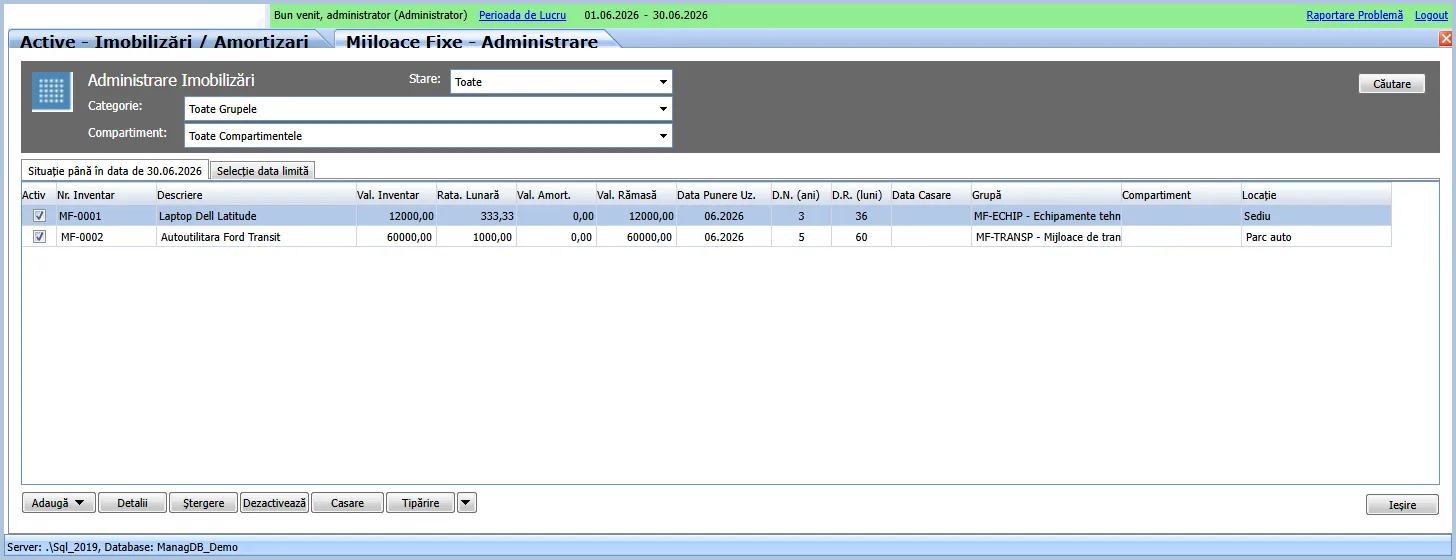
The Assets module tracks non-current assets: fixed assets (equipment, vehicles, buildings - class 21x) and low-value items (small-value assets - 303). It covers the cycle: acquisition, straight-line depreciation, disposal/sale. (Revaluation and impairment adjustments are not implemented
- see the known gaps below.)
Core concepts
Section titled “Core concepts”- Asset record: code, name, category, entry value, depreciation period, account (e.g. 2131 Technological equipment).
- Depreciation: spreading the value over the useful life. Computed periodically (monthly) and booked to depreciation expense (6811) and accumulated depreciation (281x).
- Low-value items: put into use and tracked, but expensed differently from fixed assets.
- Disposal / sale: removal from the register at end of life or on sale.
The typical flow
Section titled “The typical flow”- The reception of a fixed asset (acquisition) records it with its entry value.
- Monthly, the depreciation run generates the depreciation note (6811 from 281x).
- At the end, disposal/sale removes the asset; any gain on sale goes to revenue (7583) / expense (6583).
What the accountant sees
Section titled “What the accountant sees”- Depreciation and asset movements centralize into notes (source Fixed Assets / Assets).
- The asset register also feeds the SAF-T D406 return (assets section).
Known functional gaps
Section titled “Known functional gaps”- A per-asset depreciation schedule is already visible: the app keeps the monthly depreciation for each fixed asset and shows it as a detail grid in the asset record. What is missing is only a dedicated printable report (a listable register / “asset card”), noted for the new platform.
- Revaluation and impairment: not implemented (only acquisition + straight-line depreciation + disposal exist). For companies that revalue assets or report under IFRS, these are new-platform requirements. See the rewrite gap register (B1, B13).